On 18 May 2026, after seven years, Shield Analytics announced it was winding down. The founders were unusually direct about why: both Google and LinkedIn, they said, had made it clear that Shield could not continue operating as it was built. Its extension was pulled from the Chrome Web Store.
Shield was the default for a specific kind of person. Not agencies running client dashboards, but individuals who took their own LinkedIn seriously and wanted to know whether last quarter actually beat the one before it. It tracked impressions, engagements, follower growth and full post history. It deliberately did not write posts, generate comments, or engage on your behalf. That restraint is why people trusted it, and it is worth saying plainly that its shutdown was not deserved.
If you are here because your dashboard is disappearing, the order of operations matters more than the choice of replacement.
Do this today, before you pick anything
Export everything. Once portal access ends, that history is not recoverable from any source. LinkedIn will not resupply it. LinkedIn's own analytics are capped at a rolling window, generally about 365 days for pages and shorter for personal profiles, and there is no paid tier or API that reaches further back. Your Shield export may be the only copy of your own multi-year record that will ever exist.
Store the CSV somewhere you control, not in a trial account of whatever tool you are evaluating. You may go through two or three before settling.
If you ran an advocacy programme, tell people now. Anyone whose profile was tracked should know the tracking is ending, and any report, board deck or quarterly review that quietly sourced its numbers from Shield needs a new input before its next cycle, not after.
The uncomfortable partNo replacement can rebuild history it never watched. Every tool you evaluate, this one included, starts its record on the day you install it. The gap between Shield going dark and your replacement going live is a permanent hole in your data. That is the single strongest argument for picking something quickly, even provisionally.
The real lesson is architectural
It is tempting to read this as bad luck. It was not. Shield read LinkedIn through a browser extension and kept the resulting history on its own servers. That design meant two companies who were not Shield each held a switch: Google could remove the extension, and LinkedIn could decide the reading itself was not permitted. Both eventually used them.
This is not unique to Shield. Apollo.io and Seamless.ai were cut off in 2025. HeyReach had its company page and founder profiles banned in March 2026. The pattern is consistent enough to plan around: a LinkedIn tool built on an extension plus a vendor database has two single points of failure, and neither of them is you.
So the question to ask a replacement is not which charts it draws. It is: if this company folded tomorrow, or lost its extension, what happens to my data?
There are only really three answers. The tool holds your history on its servers, and you are in this position again. The tool uses LinkedIn's official partner APIs, which is genuinely durable but limited to what those APIs expose and generally priced for companies. Or the tool keeps the database on your own machine, which is the approach Everpost takes.
Shield and Everpost, side by side
| Shield Analytics | Everpost | |
|---|---|---|
| Status | Wound down May 2026 | Private beta, active |
| How it read LinkedIn | Chrome extension | Desktop app driving a normal browser window |
| Where history is stored | Vendor servers | A SQLite file on your disk |
| Survives vendor shutdown | No | Yes, the database is already yours |
| History beyond LinkedIn's 365 days | Yes | Yes, append-only snapshots |
| Post and profile analytics | Yes, its core strength | Yes, plus a 7 by 24 engagement grid |
| Writing and scheduling | Deliberately none | Composer, queue and real feed preview |
| Pipeline CRM and network graph | No | Yes |
| Team dashboards and advocacy roll-up | Yes | No, single user only |
| Price | Roughly 12 to 50 USD a month | Free tier, Pro 12 USD a month or 99 a year |
Where Everpost is genuinely not the answer
If Shield was holding up an employee advocacy programme, Everpost will not replace it. There is no shared dashboard, no roll-up across many tracked profiles, and no way for a marketing lead to see fifty people's numbers in one view. The database is local to one person's machine, which is exactly what makes it durable and exactly what makes it unsuitable for teams. Look at tools built on LinkedIn's official partner APIs instead.
Everpost also cannot import your Shield CSV into its charts today. Keep the file. If enough people ask for an importer it is a reasonable thing to build, but promising it before it exists would be the same kind of overclaim this page is arguing against.
What Everpost does instead
It records a snapshot every time it reads your numbers and never overwrites one. Profile views, search appearances, followers and per-post performance accumulate as a curve rather than a current figure, which is the specific thing LinkedIn refuses to give you and the specific thing Shield users are about to lose.
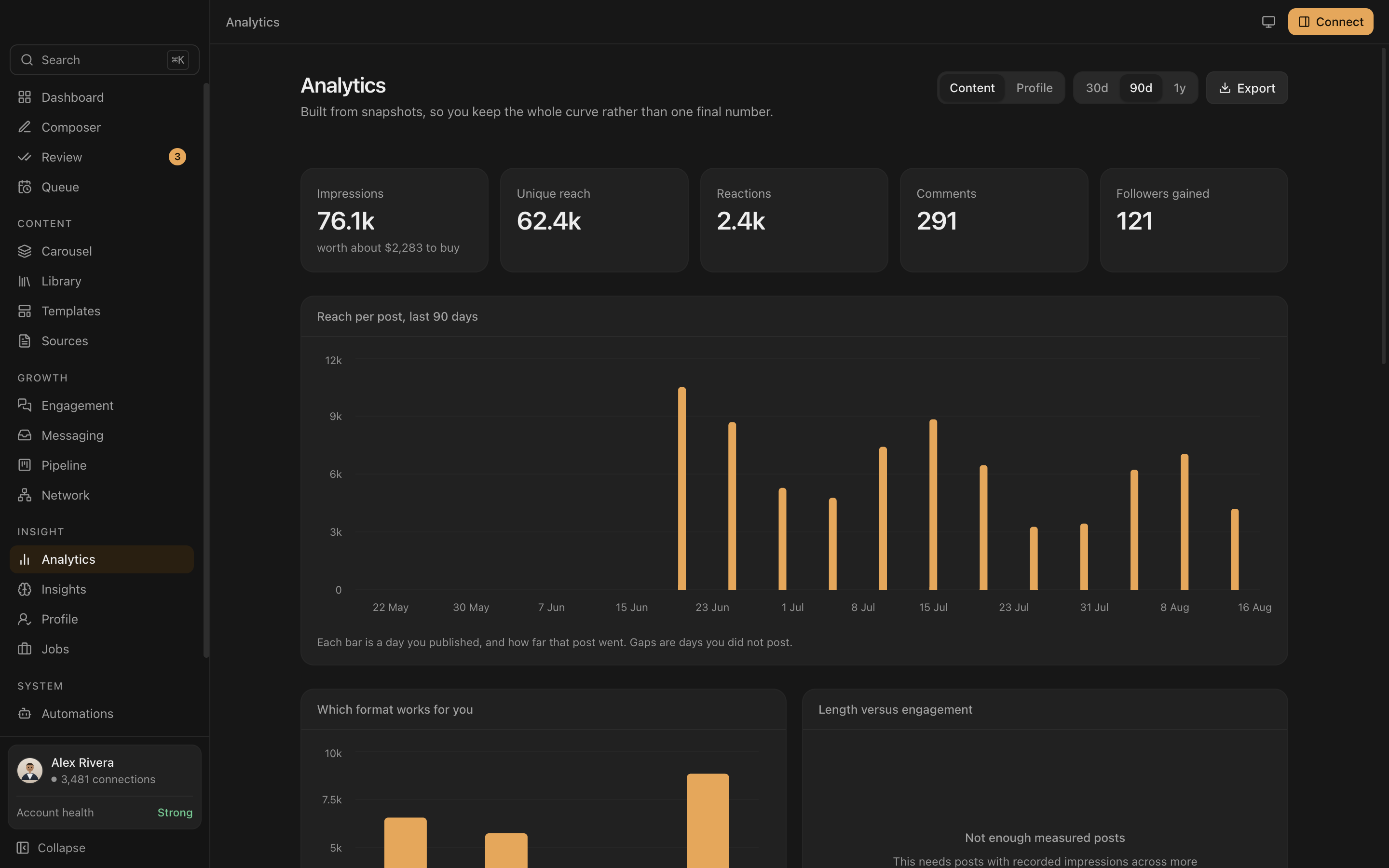
Around that it adds the things Shield chose not to do: a composer that previews a post as the feed will actually render it, a queue, a pipeline CRM built from your own connection export, and a network graph. Every AI suggestion goes to a review queue with a word-level diff, so nothing is rewritten without you seeing exactly what changed.
Publishing opens LinkedIn's own composer with your text loaded and you press post. No extension, no request replay, no background crawling. That costs one click per post and it is the reason the architecture has no Chrome Web Store dependency to lose.
Start the record before the gap gets longer
Everpost is in private beta for macOS and Windows. Builds go out in small batches.
Request early access